Fifteen minutes is enough to work through a painful memory properly, as long as those fifteen minutes follow a process.
Most people try shadow work the same way. They open a journal, pick a deep question, write for a while and close it feeling raw. The next day they pick a different question about a different part of their life. Nothing connects, so nothing resolves.
That's why so much shadow work leaves you feeling stirred up and no lighter. The part of you that is hurting gets poked, but it never gets heard, and it never gets what it needed.
This ritual fixes that with sequence. You notice the part that is reacting. You trace it back to where it started. You name what you needed then. You give it to yourself now. Then you bring that part back in instead of fighting it. Five steps, about three minutes each.
The order does most of the work. The questions do the rest, and that's where the 50 Shadow Work Journal Prompts to Heal Your Inner Child come in. They are built in these exact five stages, ten prompts each, so you never have to invent the right question while you're already hurting. Keep them open next to you and the ritual runs itself.
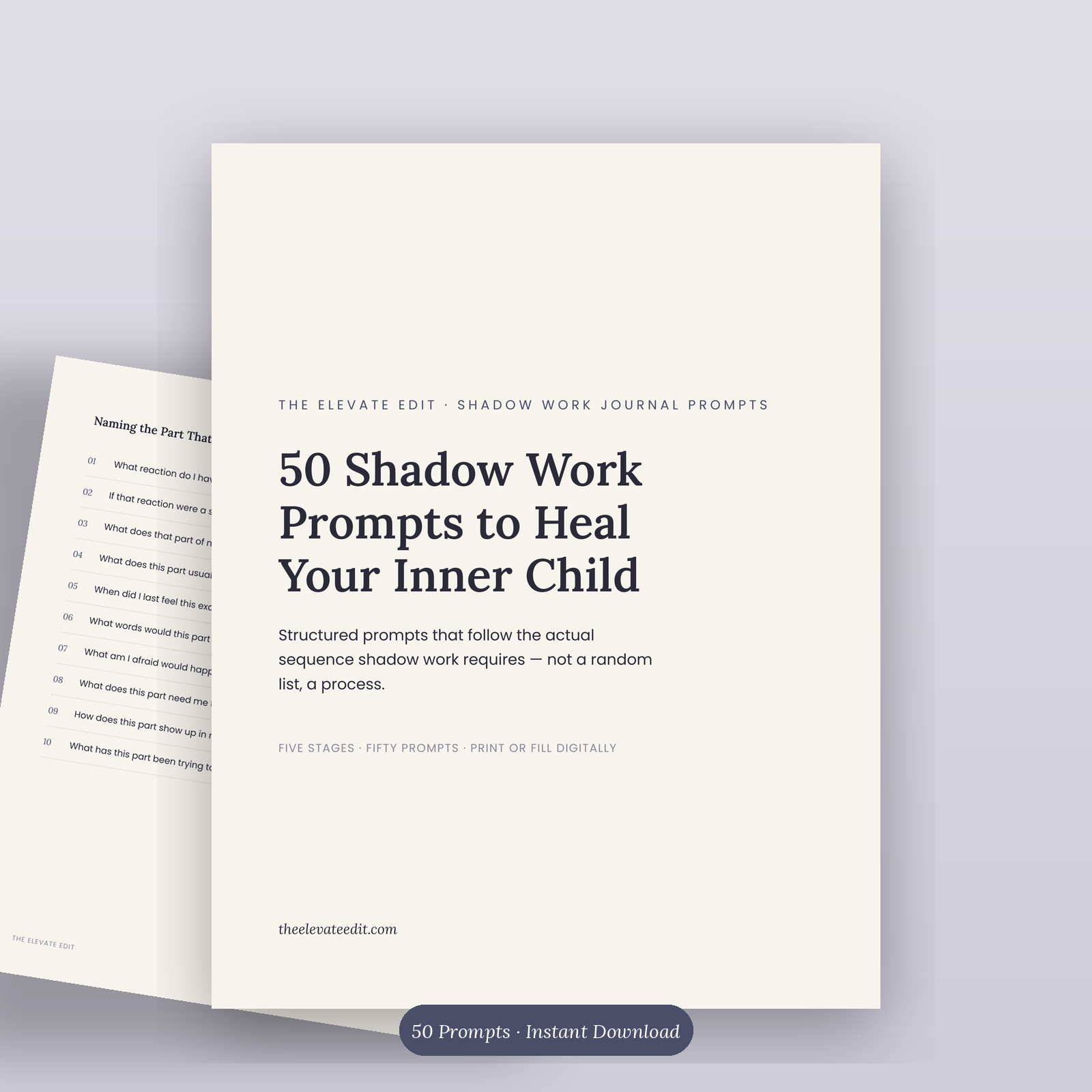
A 5-stage prompt sequence built the way shadow work actually needs to happen, not a random list of "deep questions."
Most shadow work journals hand you 50 heavy questions in no particular order. You jump from a childhood memory to a relationship pattern to a career fear, answer each one in isolation, and close the journal feeling like you touched something without ever resolving anything. That's not a discipline problem, it's a sequencing problem.
Shadow work only works if you notice the reactive part before you trace its origin, trace the origin before you name what it needed, name the need before you can meet it now, and meet it now before you can actually integrate it. Skip the order and you're just re-stirring old pain on a loop.
What's inside:
50 prompts organized into 5 sequential stages of 10 prompts each
Stage 1 — Naming the Part That's Hurting: catch the reaction before you chase the story
Stage 2 — Finding the Original Wound: trace the pattern back to where it started making sense
Stage 3 — What the Child Needed vs. What She Got: name the exact gap you're healing
Stage 4 — Reparenting: Giving It to Her Now: meet that old need for yourself, today
Stage 5 — Integrating the Shadow: stop fighting the part and bring it back into the fold
An intro page laying out why sequence matters (not just claiming it)
A closing note on returning to the process for other parts of yourself, plus a gentle nudge toward professional support if something surfaces that feels bigger than journaling can hold
How to use it: Work through the stages in order- don't skip ahead to the ones that sound more interesting. Take one prompt at a time, or one full stage in a sitting. Print it out or fill it in digitally. If a part of you resolves fully, you can start the sequence again for a different part; the same 5 stages apply.
This isn't 50 disconnected questions, it's a structured path you can return to indefinitely, for every part of yourself that needs it.
FAQ:
Do I need to know what my "shadow" is already? No — Stage 1 is designed to help you find and name it.
Is this therapy? No. It's a structured self-reflection tool, not a replacement for professional support — the closing page says so directly.
Can I do the stages out of order? You can, but the whole point is that they build on each other. Working in order is where the results come from.
Is this a fillable PDF? You can print it and write by hand, or type directly into it digitally.
What if I need to revisit it for a different issue? Run the same 5 stages again — they work for any part of you, not just one.
Before you start
This ritual is for the emotional wounds that shape how you react day to day: the old hurt behind an overreaction, a fear that keeps repeating, a pattern you can trace back to childhood. It is a self-reflection tool. It is not a replacement for professional support.
If your trauma involves abuse, violence or anything that still feels overwhelming when you think about it, work through it with a qualified trauma therapist. The prompts can sit alongside that work if your therapist agrees.
Set one rule before you begin: you are allowed to stop at any point. If your body tightens, your breathing goes shallow, or you feel numb or panicked, stop writing. Put both feet on the floor and name five things you can see. Come back another day. Stopping early is not failing. It is part of doing this safely.
For your first few rounds, choose a mild to moderate memory or reaction. Not the worst thing that ever happened. You are building the skill first.
What you need
15 uninterrupted minutes
A quiet spot where you can write without being watched
A timer on your phone
A pen and journal, or a printed copy of your prompts
The prompts matter more than they look. When you're tender, you can't come up with the next good question, and a vague question gets a vague, looping answer. The 50 prompts are sorted into the same five stages this ritual uses, so every round has ten ready-made questions that fit it. Without them, you are improvising the hardest part while you're in the middle of it.
The 15 minute ritual
Set a timer for each step and move on when it goes off, even if you're mid-thought. The time limit keeps you from spiralling and keeps each step contained. Write by hand if you can, and don't edit as you go.
All the prompts below come from the 50 Shadow Work Journal Prompts to Heal Your Inner Child. Each step uses two or three prompts from one stage, in order. Pick the ones that land hardest.
Minute 1: Settle
Sit with both feet flat on the floor. Take three slow breaths, making each exhale longer than the inhale. Then choose one reaction or recurring feeling to work with today and write one line: Today I'm working with: ...
Keep it specific. "The sinking feeling when someone leaves me on read" is workable. "My whole childhood" is not.
Minutes 2 to 4: Name the part that's hurting
This is Stage 1 of the prompts. Choose two or three:
What reaction do I have that feels bigger than the moment calls for?
If that reaction were a specific age, how old would it feel?
What does that part of me believe is about to happen?
Write fast and plain. You are not looking for the story yet. You are locating the part of you that is reacting, and giving it an age and a voice.
Why it works: you can't process something you can't locate. Putting a feeling into words also tends to turn down its intensity, which makes the next steps easier to stay with.
Minutes 5 to 7: Find the original wound
Stage 2. Choose two or three:
What's the earliest memory I have of feeling this way?
What did I have to believe about myself to survive that moment?
What was I too young to understand at the time?
You don't need a perfect memory. A season, a person or a feeling is enough. Stay with what happened and what you concluded about yourself, not every painful detail. If it starts to feel too big, that's your cue to use your stop rule.
Why it works: the reaction you named in the last step started as a sensible way to cope. Seeing where it began is what stops it feeling like a personal flaw.
Minutes 8 to 10: Name what you needed versus what you got
Stage 3. Choose two or three:
What did I need to hear back then that no one said?
What was I given instead of what I actually needed?
What need did I learn to be ashamed of having?
This is the step most people skip, and it's the one the healing hangs on. You can't close a gap you've never let yourself name. Be blunt. Write the sentence you needed to hear.
Minutes 11 to 13: Give it to yourself now
Stage 4. Choose two or three:
What can I say to myself today that I needed to hear back then?
What's one way I can meet that old need for myself this week?
What boundary would protect that younger part of me today?
Write the words directly to her, in the second person. "You didn't deserve that. I'm here now." Then pick one small action for this week and write it down with a day next to it. A boundary, a rest day, a conversation you've been putting off.
Why it works: you can't change what happened, but you can change who is meeting the need today. This is the step that turns insight into something your nervous system can actually feel.
Minutes 14 to 15: Bring her back in
Stage 5. Choose one or two:
What has this part of me actually been trying to protect all along?
What would it mean to thank this part instead of resenting it?
The goal was never to get rid of this part. It's to stop it running things from out of sight. End by writing one line of thanks to it. Then close the journal.
A 5-stage prompt sequence built the way shadow work actually needs to happen, not a random list of "deep questions."
Most shadow work journals hand you 50 heavy questions in no particular order. You jump from a childhood memory to a relationship pattern to a career fear, answer each one in isolation, and close the journal feeling like you touched something without ever resolving anything. That's not a discipline problem, it's a sequencing problem.
Shadow work only works if you notice the reactive part before you trace its origin, trace the origin before you name what it needed, name the need before you can meet it now, and meet it now before you can actually integrate it. Skip the order and you're just re-stirring old pain on a loop.
What's inside:
50 prompts organized into 5 sequential stages of 10 prompts each
Stage 1 — Naming the Part That's Hurting: catch the reaction before you chase the story
Stage 2 — Finding the Original Wound: trace the pattern back to where it started making sense
Stage 3 — What the Child Needed vs. What She Got: name the exact gap you're healing
Stage 4 — Reparenting: Giving It to Her Now: meet that old need for yourself, today
Stage 5 — Integrating the Shadow: stop fighting the part and bring it back into the fold
An intro page laying out why sequence matters (not just claiming it)
A closing note on returning to the process for other parts of yourself, plus a gentle nudge toward professional support if something surfaces that feels bigger than journaling can hold
How to use it: Work through the stages in order- don't skip ahead to the ones that sound more interesting. Take one prompt at a time, or one full stage in a sitting. Print it out or fill it in digitally. If a part of you resolves fully, you can start the sequence again for a different part; the same 5 stages apply.
This isn't 50 disconnected questions, it's a structured path you can return to indefinitely, for every part of yourself that needs it.
FAQ:
Do I need to know what my "shadow" is already? No — Stage 1 is designed to help you find and name it.
Is this therapy? No. It's a structured self-reflection tool, not a replacement for professional support — the closing page says so directly.
Can I do the stages out of order? You can, but the whole point is that they build on each other. Working in order is where the results come from.
Is this a fillable PDF? You can print it and write by hand, or type directly into it digitally.
What if I need to revisit it for a different issue? Run the same 5 stages again — they work for any part of you, not just one.
After the ritual
Don't go straight back to your inbox. Spend two minutes coming back to the present: drink a glass of water, step outside, stretch, or put on something calming. You've just spent fifteen minutes in an old feeling, so give yourself a way out of it.
How often. Three to four times a week works well. Daily is fine if it feels steady, but don't force it. Skip a day if you feel raw.
How to move through the prompts. Work through one stage at a time across a week or two before you move on, so each step builds on the last. Use the same reaction or memory across all five stages for a full round. When a round feels complete, pick a new reaction and start again at Stage 1. Different parts of you will show up, and the same five steps work for each of them.
What progress looks like. Not feeling nothing. It looks like noticing your reaction sooner, recovering from it faster, and being kinder to yourself while it's happening. Expect some days to feel heavier than others.
Four mistakes that stop it working
Skipping stages. Jumping straight to reparenting feels productive, but without the earlier steps you're comforting a part you haven't heard yet. Keep the order.
Going too deep, too soon. Starting with your hardest memory overloads you and makes you want to quit. Build up to it.
Using random questions. Pulling a different deep question each day brings you straight back to stirring things up with no resolution. Use one question set in one order.
Skipping the action. Insight alone fades. The one small action you write down in minutes 11 to 13 is what makes the change stick.
Questions people ask
Do I need to know what my shadow is before I start? No. Step one helps you find it. Start with any reaction that feels bigger than the moment.
Is this therapy? No. It's a structured self-reflection practice. For heavy or ongoing trauma, work with a qualified professional.
Can I do the steps in a different order? You can, but the order is why it works. Each step sets up the next.
What if nothing comes up? Write the most boring honest answer you have. Surface answers often open into deeper ones by the second or third prompt.
Do I need the prompts, or can I use my own questions? You can use your own. The trouble is that it's hard to write the right question when you're tender, and easy to drift into a different topic. The prompts take that decision off you.
Start tonight
You don't need a free weekend or a perfect mood. You need fifteen minutes, a pen and the right questions in the right order.
The 50 Shadow Work Journal Prompts to Heal Your Inner Child are laid out in the five stages you just read: naming the part, finding the wound, naming the gap, reparenting and integrating. Ten prompts each, instant download, print it or fill it in on your screen. Grab your copy, set the timer and begin with Stage 1 tonight.