Most people quit journaling within a week, and it's rarely because they have nothing to say. It's because they sit down with a blank page, write what they did that day, and feel exactly the same afterwards.
Therapy journaling is different. You aren't recording your day. You're using the page to sort out what you're feeling, work out why, and say the things you haven't said out loud. The page becomes a place to think, not a place to report.
The good news is that you don't need any experience. You need a few simple techniques and a reason to use each one. Here are six that work well for beginners, with a starter prompt for each so you're never staring at a blank page.
Before you start
Keep the setup simple. You need a notebook or a notes app, ten minutes, and a spot where you won't be interrupted. That's it.
Three ground rules make it easier:
Nobody will read this. Write badly, spell badly, contradict yourself.
Be honest rather than polished. The useful stuff is usually the thing you'd least like to admit.
You can stop whenever you want. If something feels too heavy, close the notebook and come back another day.
Journaling is a self-reflection tool. It is not a replacement for therapy, and if you're dealing with something that feels overwhelming, please talk to a qualified professional as well.
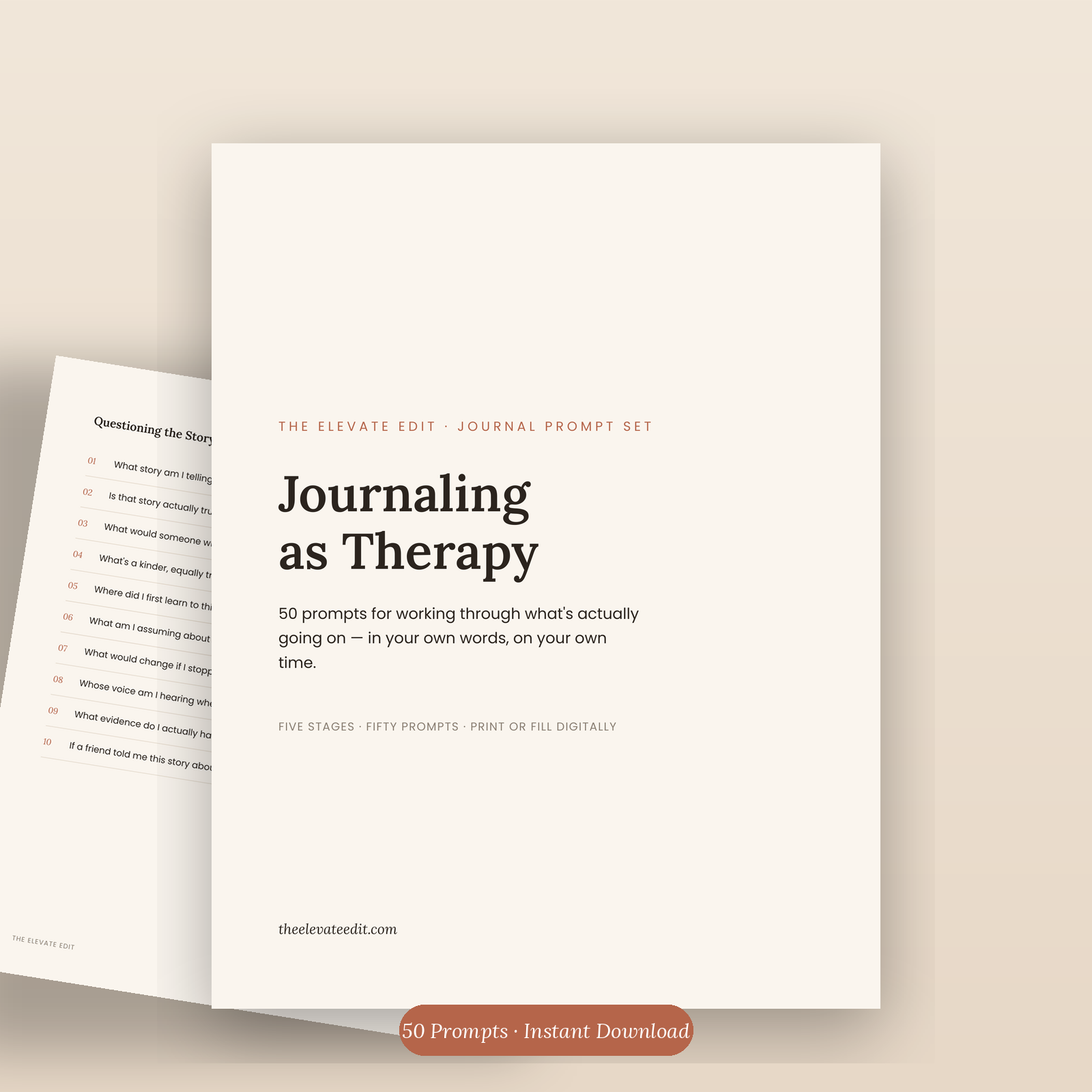
Most free prompt lists give you ten random questions. This gives you a structured set of 50, organised into five stages, so you're not just venting, you're actually working through something.
The gap:
You don't need more prompts. You need ones that go somewhere. This set is built in five stages- naming what you're feeling, questioning the story you're telling yourself, making sense of what happened, getting honest about what you need, and deciding what comes next- so each page moves you a step further instead of circling the same question.
What's inside:
50 prompts across 5 themed stages (10 each)
A short intro on how to use the set
Designed to print and write in by hand, or fill digitally
Instant PDF download. ours in seconds, keep it forever
How to use it:
Pick whichever stage matches how you're feeling today. Work through one prompt or all ten. There's no order to follow and no pressure to finish it in one sitting, just a place to think out loud on the page.
The 6 techniques
1. Timed free writing
Set a timer for ten minutes and write without stopping. Don't edit, don't cross things out, and don't worry about sense. If you get stuck, write "I don't know what to write" until something else shows up.
This gets the noise out of your head and onto the page. It's the best place to start because there's no way to do it wrong.
Starter prompt: What's taking up the most space in my head right now?
Best for: feeling overwhelmed or foggy and not knowing why.
2. Name the emotion
"Stressed" and "fine" are catch-all words that hide what's going on. This technique asks you to be more precise. Write down the feeling, then try three or four more specific words for it. Anxious, embarrassed, overlooked, disappointed and resentful are all different feelings with different causes.
Then write one sentence about where you feel it in your body and one about what set it off.
Starter prompt: If I had to describe what I'm feeling in one precise word, what would it be, and what is it responding to?
Best for: reactions that feel bigger than the situation.
3. The unsent letter
Write a letter to someone you have something unresolved with, then don't send it. Say everything you'd say if there were no consequences: what they did, how it affected you, what you needed from them.
Because it won't be read, you can be completely honest. Many people find the anger or sadness they've been carrying finally has somewhere to go.
Starter prompt: What I've never been able to say to you is...
Best for: conflict, grief, and relationships that ended without closure.
Most free prompt lists give you ten random questions. This gives you a structured set of 50, organised into five stages, so you're not just venting, you're actually working through something.
The gap:
You don't need more prompts. You need ones that go somewhere. This set is built in five stages- naming what you're feeling, questioning the story you're telling yourself, making sense of what happened, getting honest about what you need, and deciding what comes next- so each page moves you a step further instead of circling the same question.
What's inside:
50 prompts across 5 themed stages (10 each)
A short intro on how to use the set
Designed to print and write in by hand, or fill digitally
Instant PDF download. ours in seconds, keep it forever
How to use it:
Pick whichever stage matches how you're feeling today. Work through one prompt or all ten. There's no order to follow and no pressure to finish it in one sitting, just a place to think out loud on the page.
4. Challenge the thought
Our minds say harsh things as if they were facts. This technique slows that down. Write the thought exactly as it appears ("I always mess things up"), then answer three questions: What's the evidence for this? What's the evidence against it? What would I say to a friend who believed this?
Finish by rewriting the thought in a more accurate, fairer way. You're not forcing positivity. You're checking whether the thought is actually true.
Starter prompt: The thought I keep believing is... Is it a fact, or a feeling that sounds like one?
Best for: self-criticism, anxiety spirals, and imposter feelings.
5. Write to your younger self
Pick an age when something hard happened, or when you remember feeling lost. Write them a short letter. Tell them what you know now, what wasn't their fault, and what you wish someone had said.
It's gentler than most people expect, and it often brings up old hurts that are still shaping how you react today. Go slowly with it.
Starter prompt: What would I want her to know about that time?
Best for: patterns that seem to come from childhood, and learning to be kinder to yourself.
6. Honest gratitude
Gratitude journaling only works if it's real. Forced positivity makes hard days feel worse. Instead, write one thing that's hard right now, and one thing that's still good alongside it. Both can be true.
Keep it specific. "The first sip of coffee before the house woke up" beats "my family."
Starter prompt: Something that's difficult right now is... and something that's still holding me up is...
Best for: ending a session on steadier ground, and for days when everything feels heavy.
Where beginners get stuck, and what helps
The techniques work. The hard part is the moment you sit down and have to come up with the question yourself. When you're already feeling something heavy, it's difficult to know what to ask. Most people end up writing about their day, or writing the same worry in a loop, and quit.
That's the gap Journaling As Therapy: 50 Prompts to Actually Get It Out is designed to fill. It gives you 50 prompts, organised in stages, so each session starts with a question that's already been chosen for you and builds on the one before. You open it, pick a prompt, and write. No blank page, no deciding what to ask.
It pairs well with everything above. Use a prompt as the starting point for your free writing, your unsent letter or your letter to your younger self, and you'll find you go deeper, faster.
Questions beginners ask
Is therapy journaling the same as keeping a diary? Not quite. A diary records what happened. Therapy journaling explores how you feel about it and why.
How long should I write for? Ten minutes is plenty. Consistency matters more than length.
What if I feel worse afterwards? That can happen when you're writing about something painful. Finish with the honest gratitude technique, take a few slow breaths, and do something calming. If it keeps happening, talk to a professional.
Should I write by hand or type? Whichever you'll actually do. Handwriting slows you down, which many people like. Typing is faster. Both work.
Do I need prompts? You can start without them, but prompts take away the hardest part of beginning. That's why most people find they stick with journaling longer when they have them.
Start today
Pick one technique, set a timer for ten minutes and write. That's the whole plan.
When you're ready to go deeper without the guesswork, grab Journaling As Therapy: 50 Prompts to Actually Get It Out and let the prompts do the asking.