How to Upgrade Your Mental Baseline and Elevate Your Life
If you’ve ever thought, “Why does life feel harder than it needs to?” or “Why do I keep ending up in the same emotional patterns no matter how much self-work I do?”. This post is for you.
Because, most of us aren’t struggling because we lack motivation, discipline, or potential. We’re struggling because our mental baseline is outdated.
And once you understand what your mental baseline is, and how to upgrade it, everything changes.
In this blog post, I will explain everything you need to know about your mental baseline, how to upgrade it and the secret tool that will literally change the game in 2026!
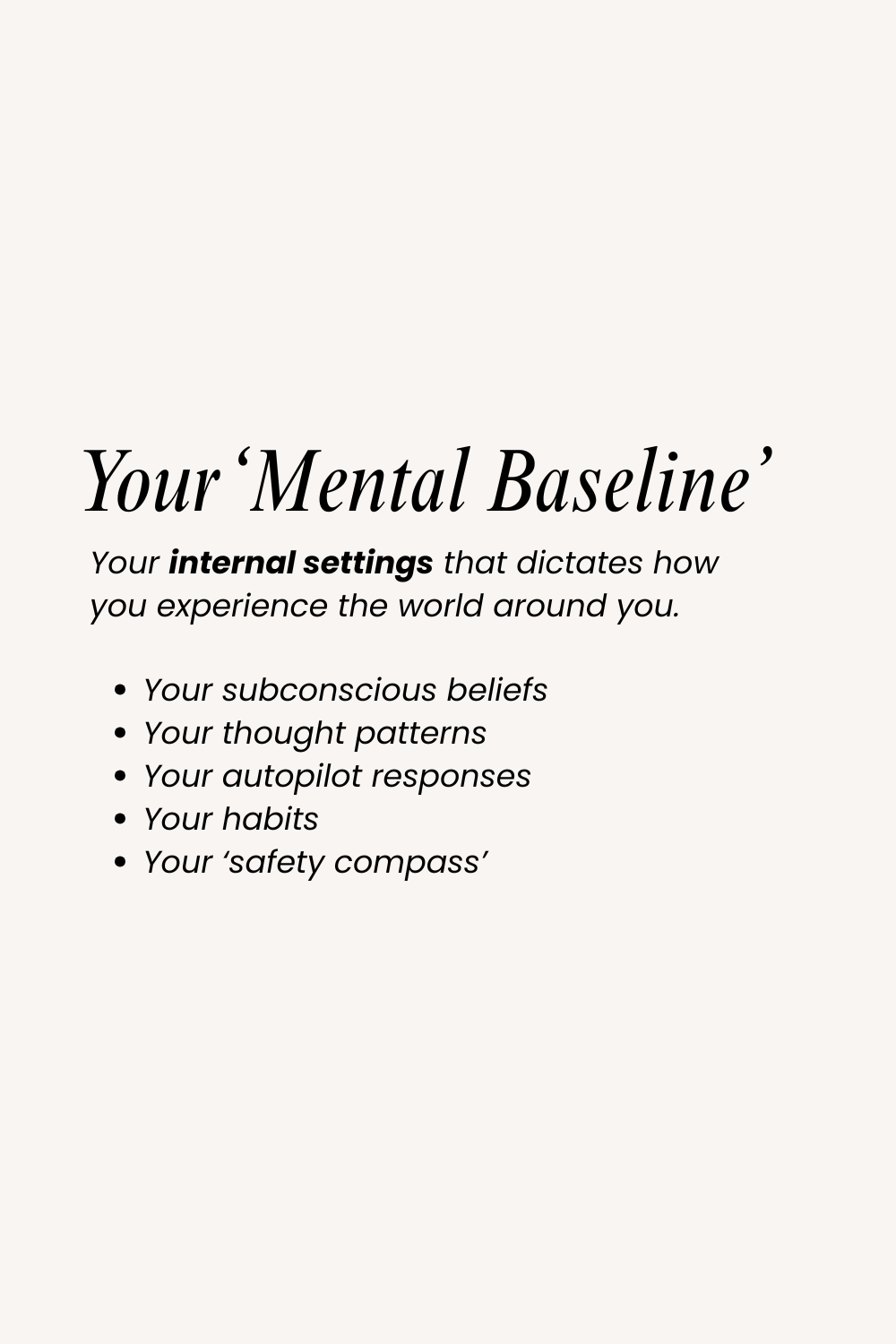
What Your “Mental Baseline” Actually Is
Your mental baseline is your subconscious programming.
It’s the invisible system running quietly in the background, shaping:
Your automatic thought patterns
Your core beliefs about yourself and the world
Your emotional default (calm vs anxious, confident vs doubtful)
Your habits and reactions
Your stress tolerance
Your internal “safety compass”
What feels normal, possible, or unrealistic to you
Your mental baseline determines how you experience your life, and what you’re capable of creating.
You don’t consciously choose most of this. Your baseline was built over time through lived experiences and, more importantly, how you interpreted those experiences.
Two people can go through the same event and walk away with completely different subconscious beliefs. One learns “I’m capable.” The other learns “I need to stay small to be safe.”
Those interpretations get stored, and then quietly run the show.
Why Self-Improvement Doesn’t Work Long Term
This is where a lot of personal development advice misses the mark.
You can journal, affirm, plan, and set goals all day long, but if your subconscious baseline doesn’t feel safe with the version of life you’re reaching for, your brain will pull you back.
That’s not self-sabotage in the way we usually think of it. It’s self-protection.
Your subconscious prioritizes safety over success every time.
So if calm, confidence, abundance, or ease don’t feel familiar or safe yet, your system will default back to what does feel safe, even if that means stress, overthinking, or playing small.
You don’t need to ‘improve yourself’. You need to upgrade your mental baseline.
How to Know If Your Mental Baseline Needs to Be Upgraded
Most people don’t realize their mental baseline is outdated because it feels normal. Familiar. “Just how I am.”
But there are some very clear signs that your subconscious is running on old programming, even if your life looks good on paper.
You might need a baseline upgrade if…
You keep thinking, “Why does this feel harder than it should?”
You’re doing the work, setting the goals, showing up, but internally it feels like you’re pushing against something invisible. That friction is usually your nervous system resisting change that doesn’t feel safe yet.
You oscillate between motivation and burnout.
You’ll have bursts of clarity and momentum, followed by crashes where you feel overwhelmed, disconnected, or exhausted. That’s a sign your baseline can’t hold the level you’re trying to live at.
Calm feels unfamiliar (or even uncomfortable).
When things are quiet, your mind looks for problems.
You’re used to being “on,” alert, or slightly stressed, and relaxing fully feels unnatural. This often means your system learned early on that vigilance = safety.
You overthink decisions you logically know are right for you.
Not because you don’t trust your judgment, but because part of you doesn’t feel safe committing, choosing, or being seen. That hesitation isn’t a flaw. It’s a baseline belief trying to protect you.
You intellectually know your worth, but don’t feel it in your body.
You’ve read the books. You can say the affirmations. But emotionally, you still shrink, doubt, or brace yourself.
This gap between knowing and feeling is a subconscious issue , not a mindset one.
You’re living a life you once wanted… but it hasn’t settled into ease.
Success, growth, or expansion has arrived, yet you can’t relax into it. Instead of enjoying it, you feel pressure to maintain it. That’s a sign your baseline hasn’t updated to match your reality.
You’re never happy with yourself. Always looking for more to ‘improve’.
You’re motivated, ambitious, and committed to ‘bettering’ yourself. Yet, you’re never happy with the outcome.
You pick yourself apart, feel insecure, and constantly find new things that need to be improved (even though you know there is nothing wrong with you!).
You have a ‘good’ life that doesn’t feel good.
Deep down, you know that you’re okay. Your life is ‘good’. You’ve achieved your goals. But it doesn’t feel good.
You still experience the same spirals, negative thought loops, stress and anxiety that you would expect to experience if life wasn’t going well.
How to ‘Upgrade’ Your Baseline
Here’s the bit that you’ve been searching for.
Your mental baseline is created by your lived experiences and the way that you interpret them. These experiences create neural pathways (chemical structures in the brain), that store your interpretations and beliefs, so that your brain can retrieve this information in the future.
To ‘upgrade’ your baseline, you need to reprogram these pathways so that the strongest pathways (the ones your brain will run on autopilot), are those that align with a baseline that supports your ‘best self’.
Neural pathways are strengthened through experience, emotional imprinting and repetition. So that’s EXACTLY what you need to do to upgrade your baseline.
Also read: How to rewire limiting beliefs
Guided imagery: The quickest way to simulate experiences and reprogram your subconscious
This is where guided imagery therapy becomes so powerful.
Your brain doesn’t fully distinguish between real experiences and vividly imagined ones. Neuroscience shows that when you imagine an experience with emotional engagement, your brain activates the same neural pathways as if you were living it.
This is called mental simulation, and it’s one of the fastest ways to activate neuroplasticity, your brain’s ability to rewire itself.
Guided imagery uses this mechanism intentionally.
Instead of waiting for life to slowly teach your nervous system that new states are safe, you can simulate safety, confidence, calm, and self-trust on purpose.
You’re not pretending. You’re training your brain.
How Guided Imagery Reprograms Your Mental Baseline
When used correctly, guided imagery can help you:
Reprocess past experiences without reliving them
Update outdated subconscious beliefs
Teach your nervous system that positive states are safe
Increase your capacity for stress and responsibility
Normalize calm, confidence, and clarity
Over time, these states stop feeling like something you have to “work at”, they become your new default.
This is how you upgrade your mental baseline.
Not by forcing yourself to think differently, but by changing what your subconscious believes is normal and safe.
The Elevate Method: Designed to Upgrade Your Baseline
The Elevate Method is built around this exact principle.
It uses guided imagery and subconscious reprogramming techniques to help you:
Identify the beliefs quietly shaping your reality
Rewire the interpretations stored in your nervous system
Build safety around growth, success, calm, and self-trust
Create permanent mindset change, not temporary motivation
This isn’t about fixing yourself. It’s about updating the internal system you’ve been running on.
Because when your baseline changes, your entire life experience elevates with it.
Upgrading your mental baseline doesn’t just help you think more positively.
It changes:
What you tolerate
What you expect
What you allow
What you move toward automatically
And that’s how real transformation happens.
If you’re tired of falling into the same patterns, and want to FINALLY experience a life that feels as good as it looks, explore the reprogramming systems available on The Elevate Method to start upgrading your baseline today.