Most articles about daily habits for happiness will tell you to journal more, wake up earlier, and say your affirmations in the mirror. This is not that article.
Not because those things are bad- some of them work for some people. But the research on what actually produces lasting happiness is more specific, more interesting, and honestly more useful than anything on a generic wellness list. And the women who genuinely seem to feel good in their lives are not necessarily the ones with the most optimised morning routines. They are the ones who have built a daily life that is quietly, consistently enjoyable to live.
That is what this list is about. Not performance. Not productivity. How your life actually feels from the inside.
These 30 habits are organised into six categories: morning, movement and body, mind, relationships, evening, and lifestyle. You do not need all 30 at once. Find the five or six that feel most relevant to where you are right now and start there.
Morning habits
1. Get outside in natural light within 30 minutes of waking
This is the single most underrated thing you can do for your mood and energy all day. Morning light exposure sets your circadian rhythm, signals your body to produce serotonin, and reduces cortisol, the stress hormone that, when elevated first thing in the morning, leaves you feeling wired, reactive, and depleted by 3pm.
You do not need to go for a run. You just need to step outside, without sunglasses, for ten minutes. Walk to get a coffee. Stand in the garden. The light does the work.
READ NEXT: 50 Morning Journal Prompts for Intention Setting
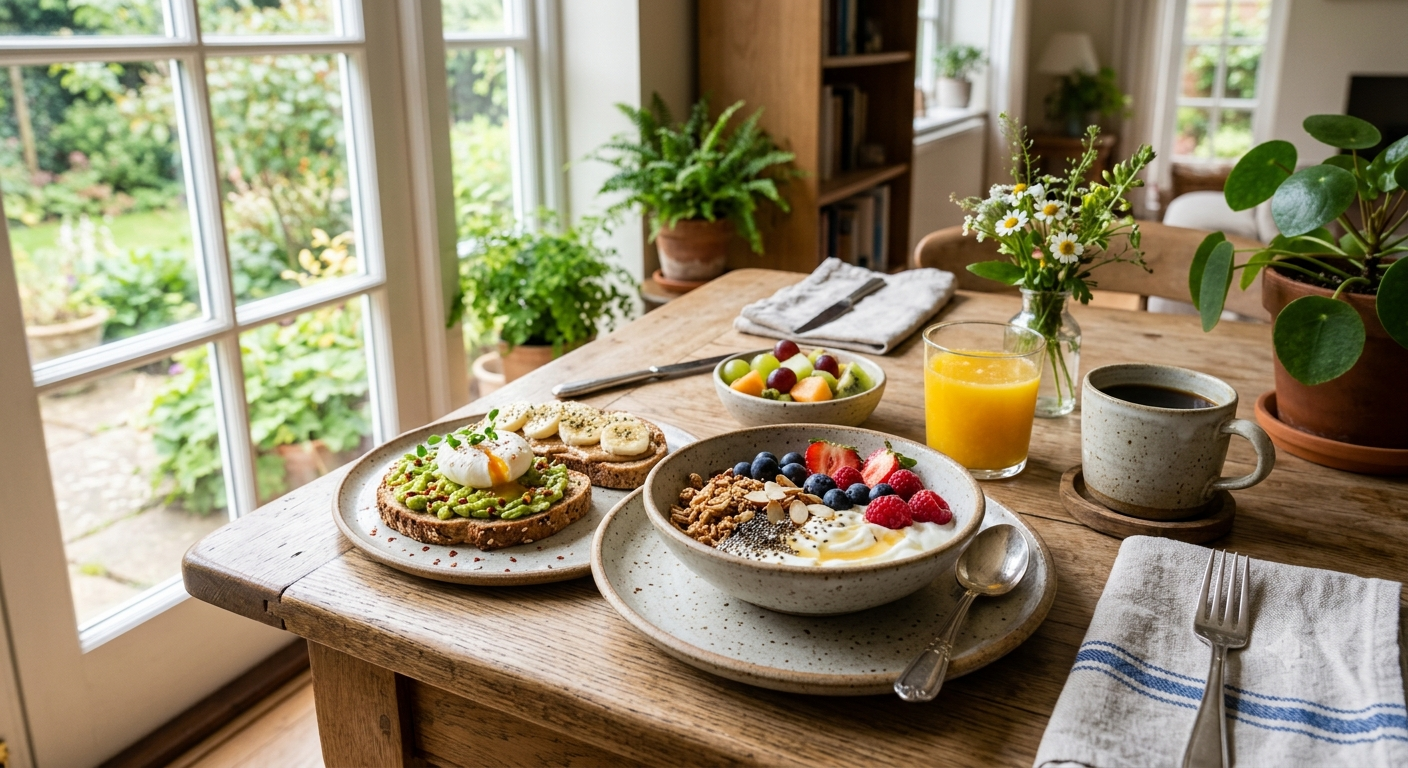
2. Eat something protein-rich in your first meal
Blood sugar stability is not a diet conversation, it is a mood conversation. When you skip breakfast or start the day on sugar or caffeine alone, your blood sugar spikes and crashes, which your brain registers as a stress response. You feel anxious, irritable, and low without knowing why.
A meal with substantial protein in the morning keeps your blood sugar stable for longer. Which means you feel steadier, calmer, and more capable of making good decisions throughout the day.
3. Leave your phone face down for the first 20 minutes
Research from Georgetown University found that even partial digital detoxes- reducing the constant stimulation from phones and social media — significantly improve positive emotions and reduce anxiety. The first 20 minutes of your morning set the psychological tone for everything that follows.
Checking your phone immediately hands control of your attention to everyone else before you have even had a chance to form your own thoughts. Keep it face down. Make your coffee. Be briefly, quietly your own person before the day makes its demands.
4. Do the task you are most dreading first
There is a specific kind of low-grade anxiety that comes from carrying an undone thing. It sits in the background all day, quietly consuming cognitive energy, what psychologists call the Zeigarnik effect. Your brain holds open loops on incomplete tasks.
Doing the thing you are avoiding first, before you check emails or settle into easier work, closes that loop early and produces a disproportionate sense of relief and momentum. The rest of the day feels lighter.
5. Choose one thing to look forward to today and protect it
Research consistently shows that anticipation is one of the most reliable predictors of happiness — and that the pleasure of looking forward to something can be as enjoyable as the thing itself. Planning a holiday makes you happy before you go. Having something small to look forward to today works the same way.
Pick something specific. A lunch you are excited about. A call with someone you love. An hour of reading with no interruptions. Then protect it. Do not let the day cancel it. The thing itself matters less than the practice of choosing joy deliberately.



Movement and body habits
6. Walk outside (not to exercise, just to walk)
Walking is one of the most reliably happiness-producing activities that exists, and most people underestimate it because it does not feel like a "proper" workout. But the research on outdoor walking and mood is robust: it reduces cortisol, improves creative thinking, and produces a measurable improvement in how people report feeling.
The "just to walk" framing matters. This is not a fitness habit. It is a thinking habit and a mood habit. Leave your headphones behind occasionally. Let your mind wander. Some of your best thinking will happen here.
You will love: Wellness Hacks I Swear By as a Female Founder
7. Cut caffeine before 2pm
Sleep quality is possibly the most underappreciated happiness variable in most people's lives. Caffeine has a half-life of around five to seven hours, which means a 3pm coffee still has half its stimulant effect in your system at 9pm — disrupting the deep sleep stages where emotional processing and mood regulation happen.
Shifting your caffeine cut-off to before 2pm is one of the simplest possible changes you can make to your sleep quality, and therefore to your baseline mood. Most people who try it notice a difference within a week.
8. Eat at least one meal away from your screen
Eating at your desk while working is a minor thing that adds up to a significant cumulative happiness drain. You get no break from stimulation, no genuine rest for your attention, and no real pleasure from the food. Cognitive restoration research shows that stepping away from tasks — even briefly, even for lunch — meaningfully improves afternoon focus and mood.
One screen-free meal per day. It does not have to be elaborate. It just has to be away from your inbox.
9. Spend time near water when you can
Marine biologist Wallace J. Nichols coined the term "blue mind" to describe the meditative, calm state humans enter near water — oceans, rivers, lakes, even a bath. The evidence behind it is solid: proximity to water reduces the stress response, slows heart rate, and produces a measurable improvement in wellbeing.
You do not need to live near the sea for this to be relevant. A walk alongside a canal, a morning swim, or even a genuinely immersive bath with no phone in sight activates the same effect. Build water into your week when you can.
10. Do one physical thing each day that makes you feel good in your body
This is deliberately vague because it is deliberately personal. Stretching for ten minutes. Dancing around your kitchen to one song. A cold shower. A walk. A yoga class. Whatever physical thing makes you feel present in your body rather than just operating it from the neck up.
The specific habit matters less than the daily practice of checking in. Your body is where your life happens. Treating it as a vehicle for getting through the day rather than something worth inhabiting is one of the quietest drains on happiness there is.

Mind habits
11. Notice when you are catastrophising (and name it!)
Catastrophising is the mental habit of jumping from a problem to its worst-case outcome. An unanswered message becomes a broken relationship. A slow month becomes a failing career. A headache becomes a serious diagnosis. It is exhausting, and most people do it without realising.
The research on cognitive defusion suggests that simply naming what is happening — "I am catastrophising right now" — creates enough distance from the thought to reduce its intensity. You do not need to fix the thought. You just need to see it for what it is.
YOU MIGHT LIKE: How to stop overthinking
12. Wait 24 hours before saying yes to new commitments
Most things that feel urgent are not important, and most decisions made under social pressure are not decisions you would make with space to think. The habit of waiting 24 hours before committing to anything non-urgent — a social plan, a favour, a new project — gives you enough distance to check whether you actually want to do it or whether you are just avoiding the discomfort of saying no.
Over time, this habit quietly transforms the quality of your schedule from "full of things I had to do" to "full of things I chose."
13. Stop narrating your mistakes as personality traits
There is a significant difference between "I handled that badly" and "I always handle things badly." The first is an observation. The second is an identity statement that your brain will unconsciously work to confirm.
The habit is small and specific: when you catch yourself saying "I always," "I never," "I am terrible at," — stop, and reframe it as a behaviour rather than a character. This is not positive thinking. It is accurate thinking. One bad week is not who you are.
14. Let yourself be genuinely bad at something new
Perfectionism and happiness are in constant tension. One of the most consistently cited findings in the positive psychology literature is that learning and mastery produce sustained happiness in a way that comfort and familiarity do not. But learning requires being bad at something first, which perfectionism makes almost unbearable.
Pick something you want to learn and commit to being a beginner at it — badly, visibly, without apology. The discomfort passes quickly. The satisfaction of being in genuine motion does not.
15. Do a partial digital detox every day
Georgetown University research published in 2026 found that even partial digital detoxes produce significant improvements in positive emotions and reduction in anxiety. Full digital detoxes are not realistic for most people — but creating a window each day where you are not consuming content is.
This does not have to be dramatic. It can be a walk without headphones. The lunch without your phone. The first 20 minutes of the morning before you check anything. The goal is less about screen time as a metric and more about giving your attention a daily period of genuine rest.
CHECK OUT: The Best Scottish Highland Retreats for a Digital Detox
16. Close your working day with intention
Most people end their working day by drifting away from their desk — a meeting runs over, they check one more email, they half-switch off for an hour before properly stopping. This means there is no clear psychological line between work and the rest of life, which keeps the brain in a low-level "on" state all evening.
A closing ritual does not need to be elaborate. Write down the three things you are carrying to tomorrow, close your laptop, and say — out loud or internally — "work is done." The specificity of the ending is what creates the psychological off-switch that makes your evenings actually restorative.



Relationship habits
17. Have at least one non-transactional conversation every day
A 2025 study by Elizabeth Dunn and colleagues found that social interaction is robustly linked to happiness, but the quality of the interaction matters as much as the quantity. Transactional conversations (logistics, scheduling, problem-solving) do not produce the same happiness benefit as genuine connection.
A non-transactional conversation is one where you ask how someone is and mean it. Where you share something real. Where the conversation exists for its own sake rather than to accomplish something. It can be short. It just has to be real.
18. Tell people when they have done something well
Most people feel appreciation more often than they express it. The habit of saying it out loud — specifically, not vaguely — is one of the simplest relationship investments you can make. "That thing you said last week genuinely helped me" costs nothing and produces a warmth in both directions that generic social contact does not.
It also, quietly, trains your attention toward what is good in the people around you rather than what is lacking. That shift in attention has a compounding effect on how you feel about your relationships over time.
19. Invest 10 deliberate minutes in a relationship that matters
The Harvard Study of Adult Development — 85+ years of research into what makes people happy — found that the quality of close relationships is the single most important predictor of long-term happiness. Not the number of relationships. The depth of a few.
Ten deliberate minutes — a voice note, a real phone call, a message that is more than a meme — invested in a close relationship every day compounds over months and years into the kind of connection that research consistently identifies as the foundation of a good life.
20. Do one kind thing for someone else
Research from Georgetown University neuroscientist Abigail Marsh found that helping others — even small, everyday acts of kindness — produces genuine happiness that outlasts the self-focused pleasures most happiness advice focuses on. Taking a bath or buying yourself something produces a brief pleasure. Doing something genuinely useful for another person produces something closer to meaning.
This does not need to be significant. It can be letting someone ahead of you, sending a message to check in, making a cup of tea for someone who needs it. The habit is the practice of looking outward once a day.
21. Let yourself receive well
This one is the flip side of giving — and arguably harder for most women. Receiving a compliment without deflecting it. Accepting help without immediately reciprocating. Letting someone do something for you without feeling the need to minimise it or pay it back immediately.
The inability to receive well is almost always connected to self-worth. Getting better at it is both a self-worth practice and a relationship investment — because people who care about you want to be able to give to you, and deflecting it consistently is a form of distance.



Evening habits
22. Put your phone in a different room at night
Not "reduce screen time before bed" — that is vague enough to be meaningless. This is specific: your phone lives in a different room when you sleep. Not face down on the nightstand. Another room.
The research on sleep quality and the phone is unambiguous. The blue light, the notification anxiety, the last-thing-you-see-before-sleeping effect on your subconscious — all of it degrades the quality of sleep that is the foundation of your mood, your patience, your cognitive function, and your happiness baseline. Buy an alarm clock. Move the phone.
23. Create a transition between work and the rest of your day
Psychological detachment from work — the ability to genuinely switch off — is one of the strongest predictors of evening wellbeing and next-morning energy in the research. Most people do not detach. They sit with the low-level background noise of work anxiety all evening.
A transition ritual creates the gap. It can be changing your clothes, a short walk, a specific playlist, a cup of tea in a particular spot. The content matters less than the consistency. When you do this thing, you are off. Over time, your nervous system learns the signal.
24. Notice one moment today that made you feel genuinely alive
Not three things you are grateful for. One moment that made you feel genuinely present, connected, or alive. It might be small — a conversation that lit you up, a piece of music, the light at a particular moment, food that tasted good.
This is called savoring — and the research behind it (particularly Fred Bryant's work) shows that actively attending to positive experiences rather than just passing through them significantly increases their impact on mood. The noticing is what makes it real.
25. Keep a consistent sleep and wake time — including weekends
Social jetlag — the disruption to your circadian rhythm from sleeping different hours on weekends — is one of the most reliable predictors of low mood, poor metabolic health, and cognitive impairment through the week. Most people do not connect Monday morning misery to Saturday's 1am bedtime.
A consistent wake time, even on weekends, is the single most evidence-backed sleep intervention there is. You do not have to go to bed at the same time. You do have to wake up at the same time. Your body does the rest.
Lifestyle habits
26. Spend money on experiences rather than things
The research here — particularly from Elizabeth Dunn and Michael Norton, whose work is the basis for the book Happy Money — is some of the most replicated in positive psychology. Material purchases produce a brief happiness spike that fades quickly as you adapt to the new thing. Experiences produce memories, stories, and connection that do not diminish in the same way.
This does not mean never buy anything. It means when you have discretionary money to spend, consistently choosing the meal out with a friend over the new item, the weekend trip over the new coat, will produce more sustained happiness over time.
27. Collect small pleasures deliberately
Happiness researchers distinguish between pleasures (brief, sensory, immediate) and meaning (deeper, longer-term). Both matter. The mistake most high-achieving women make is chasing meaning while neglecting pleasure — dismissing the small, immediate joys as trivial while pursuing something worth feeling good about.
The habit is consciously building small pleasures into each day. The coffee that is exactly right. The specific podcast on a specific walk. The fifteen minutes of reading before anyone needs anything from you. These things are not trivial. They are the texture of a life that feels worth living.
28. Keep one commitment to yourself every week, no exceptions
Most people are significantly better at keeping commitments to other people than to themselves. The habit of having one non-negotiable weekly commitment to yourself — something you have said you will do for your own wellbeing, creativity, or growth — and actually keeping it regardless of how busy the week gets, is one of the most direct self-worth investments you can make.
Not because the specific thing matters enormously. Because the practice of being someone who keeps their word to themselves is foundational to everything else.
29. Do something with your hands regularly
There is a specific satisfaction that comes from making something physical — cooking a meal from scratch, gardening, pottery, drawing, baking, anything that produces a tangible result from manual effort. Psychologists call this the "maker effect" — the disproportionate satisfaction we feel from things we have made ourselves.
In a life increasingly dominated by abstract, screen-based work with no clear endpoint, the simplicity of making something and seeing it finished is genuinely restorative. It does not need to be artistic or skilled. It just needs to be physical and made by you.
30. Protect at least two hours of genuinely free time every day
A 2021 study found that less than two hours of daily free time is linked to lower happiness — but so is too much. Two to five hours of genuine free time daily is where happiness is optimised. Most working women are significantly below two hours, especially if they have children or demanding careers.
Free time is not scrolling time. It is time without obligation or productivity pressure — time that belongs to you to spend however you want. Protecting it means treating it as seriously as you treat your work calendar. It is not a reward for getting everything else done. It is a requirement.
Before you go…
Thirty habits is a lot. Please do not try to implement all of them at once. The research on habit formation is clear: attempting too many changes simultaneously is one of the most reliable ways to end up implementing none of them.
Pick three. Specifically, pick the three where you thought "that one" the moment you read them. Those are the ones your life is currently missing. Start there. Give them two weeks before adding anything else.
Happiness is not a destination that appears when your life finally looks the way you want it to. It is the accumulated result of small, consistent choices about how you spend your days. These are thirty of the best ones.
If you’re curious about which area of your life is costing you the most happiness, take our free Happiness Audit!