25 Intentional Living Habits to Build in 2026
There's a quiet shift happening. And if you've felt it, you'll know exactly what I mean.
After years of hustle culture, optimisation obsession, and the relentless pressure to be a "better version" of yourself, something is changing. People are tired of reinventing themselves every January. They're done chasing an idealised life that always seems to exist somewhere just out of reach.
What they want instead, what you probably want, if you're here, is a life that actually feels good to live in. Not a life that looks impressive from the outside, but one that feels calm, purposeful, and genuinely yours from the inside.
That's what intentional living is really about. Not perfection. Not productivity hacks. Just a series of small, conscious choices that add up to something meaningful over time.
Here are 25 habits worth building in 2026.
1. Start the Day Before You Look at Your Phone
This one is deceptively simple, and that's exactly why it works.
The moment you reach for your phone first thing in the morning, you hand the steering wheel of your attention to everyone else.
Messages, notifications, news, other people's opinions, all of it floods in before you've even had a chance to check in with yourself.
Try giving yourself ten minutes of phone-free time first. Make a drink. Sit by a window. Just be a person in a quiet room. It's a small act of reclamation, and it changes the tone of the entire day.
2. Audit Your 'Yes' Pile
Intentional living starts with what you agree to.
Most of us are walking around with a calendar full of commitments we said yes to out of guilt, obligation, or fear of missing out, not because we actually wanted to. That quiet resentment builds up slowly until one day you feel busy and empty at the same time.
This year, make it a practice to pause before you agree to anything. Ask yourself: if this were next week, would I still want to do it? If the answer is no, that's your answer.



3. Build a Morning Ritual (Not a Morning Routine)
The difference matters. A routine is something you do. A ritual is something that means something.
Even if you only have fifteen minutes, you can create a short sequence of actions that signals to your mind and body: this is my time, this is my day beginning. It might be journalling, movement, a slow coffee, a few minutes of stillness. It doesn't need to be aspirational. It just needs to be yours.
4. Create a Sunday Reset Practice
This is one of the most searched habits on Pinterest right now, and for good reason. A Sunday reset isn't about deep cleaning your entire flat or planning every minute of the week ahead. It's about creating a small bridge between one week and the next.
Clear a surface. Write down three priorities for the week. Prep something simple for Monday. Light a candle. The specifics matter less than the intention: I am entering the week with a little more ease than I left the last one.
5. Spend Money in Line with Your Values
One of the most underrated forms of intentional living is conscious spending, not frugality for its own sake, but directing your money toward the things that genuinely matter to you and quietly removing it from the things that don't.
This isn't about budgeting in the traditional sense.
It's about noticing the gap between what you say you value and where your money actually goes. That gap is always more revealing than we'd like it to be.

6. Stop Optimising Your Rest
Rest is not the reward you get after you've been productive enough. It's not something you have to earn. It's a non-negotiable part of being a functioning, creative, emotionally regulated human being.
This year, try treating rest as a legitimate part of your schedule — not the thing that gets squeezed out when everything else runs over. Book it. Protect it. And stop feeling like you need to justify it.
7. Cultivate One Truly Offline Hobby
Not a side hustle. Not something you photograph and share. Just something you do because you love it, something that exists entirely outside the algorithm.
Reading. Drawing. Cooking from a cookbook. Growing things. Walking without headphones. The offline hobby is becoming quietly radical in a world where everything we do is somehow content, data, or both.
8. Get Honest About Your Inputs
You are, to a significant degree, the sum of what you consume, the content, the conversations, the media, the people you spend time around. Most of us don't audit this nearly as much as we should.
Notice how you feel after different inputs. Does a certain account leave you feeling inspired or depleted? Does a particular friendship energise you or consistently drain you? Intentional living means being willing to see the answer clearly, even when it's uncomfortable.



9. Write Things Down
There's a reason journalling keeps showing up in every wellness conversation: it works. Not because it's therapeutic in a clinical sense (though it can be), but because getting your thoughts out of your head and onto a page creates space. It gives you a little distance from your own noise.
You don't need a beautiful leather journal or a structured prompt system. A notebook from the corner shop and a consistent five minutes will do more for your mental clarity than most things.
10. Eat at a Table
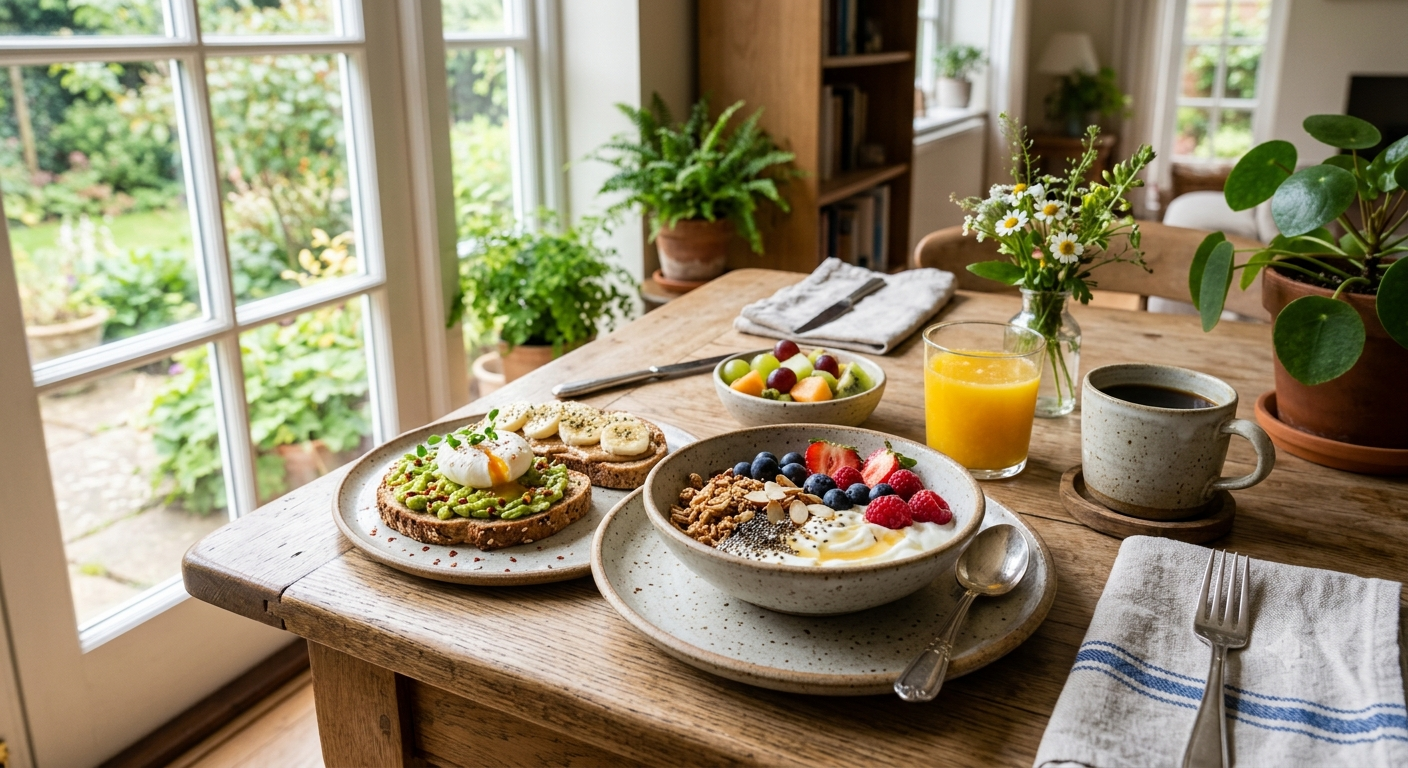
This sounds almost embarrassingly small. But the habit of sitting down at a table to eat — without a screen, without scrolling, just with your food and your own thoughts or the people you love — is quietly disappearing.
It's one of the simplest forms of presence there is. It's free. It requires nothing except the decision to do it. And the ripple effect on how you feel is surprisingly significant.
11. Say What You Actually Mean
Intentional living isn't just about how you organise your time. It's about how you show up in relationships.
So much energy goes into softening, hedging, hinting, and hoping people will read between the lines. Learning to say what you actually mean — clearly, kindly, without excessive qualification — saves enormous amounts of emotional energy and tends to make your relationships better in the process.
12. Give Yourself a Genuine Weekly Wind-Down
The transition between work and rest is something most people rush through without noticing. You close the laptop and immediately open your phone. You leave the office and mentally never leave at all.
A proper wind-down doesn't have to take long. It's just a consistent signal that the working part of the day is done. Change clothes. Make something warm to drink. Take a short walk. Whatever works for you — the point is the deliberate transition, not the activity itself.
13. Spend Time in Nature Without an Agenda
Not exercise. Not a podcast walk. Just being outside without anything to accomplish.
Research consistently shows that even short periods of time in natural environments reduce cortisol, lower mental chatter, and restore a sense of perspective. But beyond the science, there's something about being somewhere that doesn't need anything from you that is genuinely hard to find elsewhere.
14. Declutter in Layers, Not All at Once
The pressure to do a complete life overhaul in a single weekend is exhausting and mostly doesn't work. A big declutter event feels transformative in the moment and slowly reverts because nothing about your underlying relationship with stuff has changed.
Instead, try small, regular layers. One drawer. One shelf. One category of clothing. Over the course of a year, the cumulative effect is significant — and it actually sticks.



15. Learn to Tolerate Boredom
This might be the most countercultural habit on this list.
We have become collectively terrible at sitting with a quiet moment. Any gap in stimulation is immediately filled — phone out, something to watch, something to scroll. But boredom, as it turns out, is actually where creativity and self-knowledge live. The thoughts you're avoiding have to surface eventually. Better to give them a proper time and place.
Try sitting for five minutes with nothing. It will feel more uncomfortable than you expect. That discomfort is the point.
16. Prioritise Depth Over Volume in Your Social Life
Intentional living often means having fewer plans but better ones. A long lunch with someone you genuinely love versus three rushed coffee dates with people you barely know. A weekend at home that actually restores you versus back-to-back events you said yes to because you thought you should.
Quality of connection matters far more than the quantity of it, and most of us already know this. The practice is in letting yourself actually live by it.
17. Build a Relationship With Your Own Finances
Financial clarity isn't just practical — it's profoundly grounding. Knowing where you stand, even if where you stand is less comfortable than you'd like, removes a background hum of anxiety that many people carry without even identifying it as financial stress.
You don't need to become an expert. You just need to stop avoiding it. Open the account. Look at the numbers. Know what's coming in and what's going out. Start there.
18. Move Your Body in a Way You Actually Enjoy
The fitness culture conversation has been shifting for a while now, and it's worth paying attention to. Movement as punishment, movement as penance for eating, movement as something you grit through — none of these approaches lead anywhere sustainable.
Movement you enjoy comes from a completely different place. It's self-care rather than self-correction. It tends to stick. And it makes you feel better in ways that go well beyond the physical.
19. Create Small Moments of Beauty in Your Everyday Space
This doesn't mean expensive décor or perfectly curated interiors. It means noticing that a small bunch of flowers on your desk changes the feeling of a room. That your morning coffee tastes better in a mug you actually love. That clearing the kitchen counter before bed means waking up to a space that already feels calm.
Tiny aesthetic choices accumulate into an environment that either supports how you want to feel or quietly works against it.
20. Ask Better Questions of Yourself
Most people's internal dialogue is running in the background on autopilot — often critical, often repetitive, and rarely particularly useful. Intentional living means occasionally stepping in and choosing better questions.
Instead of why does this always happen to me, try what would I need to feel differently about this? Instead of what's wrong with me, try what do I actually need right now? The quality of your inner life is shaped, more than most of us realise, by the questions you're unconsciously asking yourself all day.
21. Protect Your Sleep with More Seriousness
Sleep is having its cultural moment, and not before time. The research on what chronic poor sleep does to mood, cognition, physical health, and emotional regulation is stark and consistent. And yet most of us still treat a good night's sleep as a nice-to-have rather than a foundation.
A consistent bedtime. A genuinely dark room. Cutting caffeine earlier than you think you need to. These are not glamorous habits, but they are transformative ones.
22. Build a Practice of Regular Gratitude — But Make It Specific
Generic gratitude lists can start to feel performative over time. The version that actually works is more granular: not "I'm grateful for my family" but "I'm grateful that my sister sent me a voice note this morning that made me laugh."
Specificity keeps it real. And real gratitude — the kind that's rooted in actual moments rather than abstract categories — genuinely changes how you move through the world.
23. Take Your Commitments to Yourself Seriously
This one is subtle but significant. Most of us are reliably good at following through on commitments to other people and quietly flexible — sometimes to the point of non-existence — on commitments to ourselves.
I'll start on Monday. I'll do it when things calm down. I'll sort that out next month. Treating your own goals, boundaries, and intentions with the same seriousness you'd bring to a professional commitment is one of the quietest and most powerful forms of self-respect.
24. Create White Space in Your Schedule
An over-scheduled life feels chaotic even when everything in it is technically good. White space — time that isn't assigned to anything — isn't wasted time. It's the space where you recover, think, integrate, and actually enjoy the life you're building.
It won't appear by accident. You have to put it in the calendar and treat it with the same protectiveness you'd give any other important commitment.
25. Choose Your Life Actively, Not by Default
This is the one that sits underneath all the others.
Intentional living is, at its core, the practice of choosing. Choosing how you spend your time rather than letting it be filled by default. Choosing who you spend it with rather than ending up with whoever's easiest or nearest. Choosing what you give your energy to rather than dispersing it across whatever demands it loudest.
None of this requires a dramatic life overhaul. It doesn't require you to quit your job, move somewhere new, or reinvent yourself from the ground up. It just requires the small, repeated act of asking: is this a choice, or am I just going along with things?
And then, slowly, quietly, choosing differently.
The point of intentional living isn't to achieve some perfect version of your life — it's to feel genuinely present in the one you're already in. Start with one habit. Let it settle. Build from there.
Which of these resonates most with where you are right now?